

New York has enacted a new annual tax on high-value New York City homes that are not the owner’s primary residence — the “pied-à-terre tax” (PAT Tax). It was signed into law May 28, 2026, takes effect July 1, 2026, and sunsets June 30, 2031, unless extended.
Who’s Affected
The tax applies to any “covered owner” — an individual owner, trust beneficiary, or majority owner of an entity — whose New York City co-op, condo, or 1–3 family home is not a primary residence. It applies even to owners who already pay NYC and NY State income tax, since only one home can be an individual’s primary residence.
A property is exempt if it’s the primary residence of a covered owner or immediate family member, or if it’s leased to a NYC primary resident for a year or more. Residency is measured as of January 5 preceding the fiscal year.
Rates
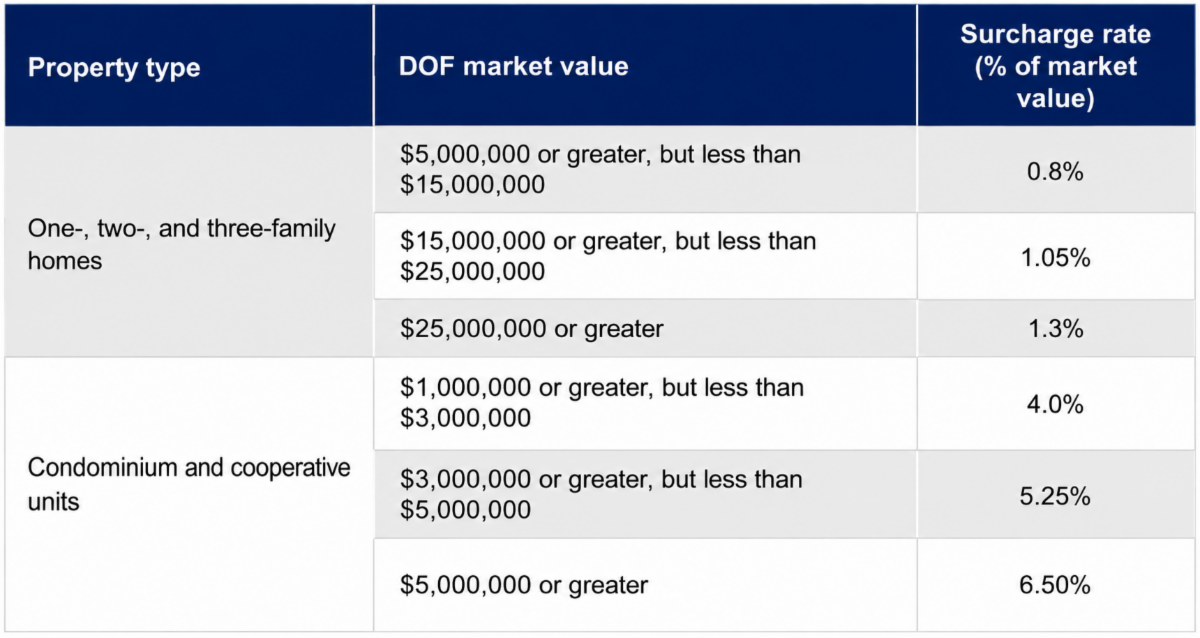
The tax phases in over two periods as the city develops a sales-based valuation method for co-ops and condos: Phase 1 runs July 1, 2026 – June 30, 2028, on existing assessed values; Phase 2 runs July 1, 2028 – June 30, 2031, on a new comparable-sales valuation, with the threshold rising to $5 million for all property types.
For property tax years 2026-27 and 2027-28, the surcharge will generally apply as follows:
Key Deadlines
- Updated August 1, 2026: The City extended the exemption filing deadline by four weeks, from the original August 21/24 dates to a single September 18, 2026 deadline for all property types, following criticism over the rollout.
- July 24, 2026 — DOF published the supplemental market value roll identifying properties that may be subject to the surcharge.
- September 18, 2026 — Extended exemption application deadline for all property types (1–3 family homes, condominiums, and cooperative apartments). Applies to any owner who received a “You may be subject to…” notice from DOF.
- December 31, 2026 — DOF expected to publish the final list of properties subject to the surcharge.
- January 1, 2027 — Surcharge, if applicable, will first appear on the property tax bill due this date.
DOF has begun issuing notices to owners preliminarily identified as subject to the surcharge; receipt of a notice is not a final determination.
Compliance
- Penalties up to 50% apply for inaccurate or bad-faith documentation; DOF may audit certifications for six years.
- Unpaid tax is enforced like real property tax, including liens; appeal rights are limited to the NYC Tax Commission and RPTL Article 7 review.
- Co-op boards are responsible for passing the tax through to affected shareholders and face building-wide lien exposure if a shareholder doesn’t pay.
How to File an Exemption
- Eligibility guide
- Exemption application — homes and condos (due September 18, 2026)
- Exemption application — co-ops (due September 18, 2026)
- Program overview
- Tax Commission appeal (if a value or exemption denial is disputed)
Recommended Action
Owners of NYC second homes, co-ops, or condos — especially those held through LLCs or trusts — should confirm primary-residence documentation now and file for an exemption before the extended September 18, 2026, deadline. Contact us with any questions and to review your situation.